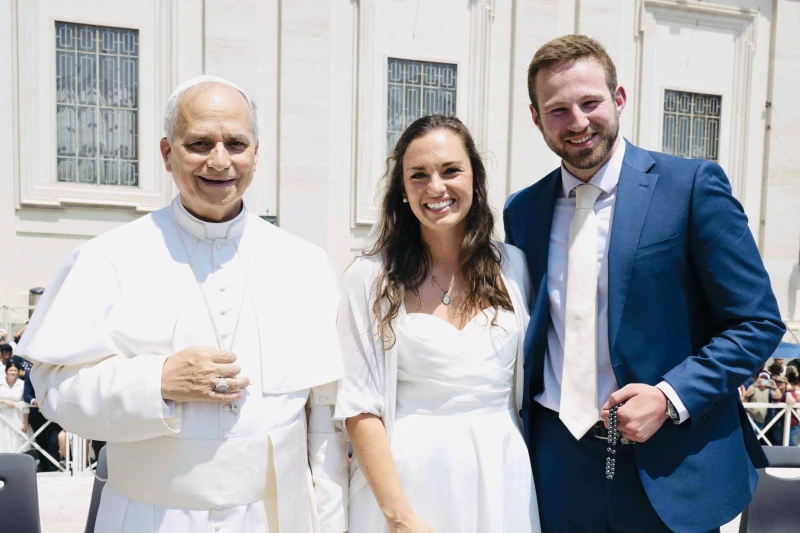
Newlyweds Anna and Cole Stevens meet Pope Leo XIV at the general audience in Rome on Wednesday, June 11, 2025. / Credit: Courtesy of Anna and Cole Stevens
Vatican City, Aug 7, 2025 / 13:54 pm (CNA).
In a video message to the participants of the third congress of the Pan-African Catholic Network for Theology and Pastoral Care, Pope Leo XIV recalled the fundamental role of the family, “the first place where we receive the love and support we need.”
The event, titled “Walking Together in Hope as the Church-Family of God in Africa,” is taking place Aug. 5–10 at the Catholic University of West Africa in Abidjan, Ivory Coast.
The main objective of the meeting is to promote communication within the global south by bringing together theologians, pastoral, lay, and religious leaders to reflect, share experiences, and develop pastoral ministry from an African perspective.
At the beginning of his message, released Aug. 6, the Holy Father particularly expressed his gratitude for the work of the meeting’s organizers and assured them of his prayers for the participants, who during these days are reflecting on the future of the Church in Africa.
In the context of the Jubilee of Hope, Pope Leo XIV emphasized the vital role that hope plays in our earthly pilgrimage. “Faith and theology provide the basis for knowing God, while charity is the life of love we enjoy with him,” he noted.
However, he explained that “it is by the virtue of hope that we desire to attain the fullness of this happiness in heaven. Thus, it inspires and sustains us to grow closer to God even when confronted by the hardships of life,” he added.
The Holy Father urged the Church to be “a beacon of hope for the nations” facing various difficulties in Africa, while calling for fraternity and appealing to the responsibility to “look after each other.”
“A family is usually the first place where we receive the love and support we need to move forward and overcome the trials we face in life,” he pointed out.
In this context, he encouraged the continued building of “the family of the local Churches” in African countries “so that there are networks of support available to all our brothers and sisters in Christ, and also to the wider society, especially those on the peripheries.”
At the end of his message, Pope Leo XIV emphasized the importance of “recognizing the unity between theology and pastoral work.”
He pointed out that “we have to live what we believe. Christ told us that he came not simply to give us life but to give it to the full. Hence, it is your task to work together to implement pastoral programs that demonstrate how the teachings of the Church help to open people’s hearts and minds to the truth and love of God.”
This story was first published by ACI Prensa, CNA’s Spanish-language news partner. It has been translated and adapted by CNA.
If you value the news and views Catholic World Report provides, please consider donating to support our efforts. Your contribution will help us continue to make CWR available to all readers worldwide for free, without a subscription. Thank you for your generosity!
Click here for more information on donating to CWR. Click here to sign up for our newsletter.
Vatican City, Dec 12, 2019 / 04:42 am (CNA).- Pope Francis Thursday accepted the resignation of Bishop Paul Joseph Swain of Sioux Falls, South Dakota, and appointed Minnesota priest Fr. Donald Edward DeGrood as his successor.
Bishop of Sioux Falls since 2006, Swain’s resignation was accepted after he reached in 2018 the age of 75, the minimum age of retirement for diocesan bishops.
Bishop-elect DeGrood, 54, grew up outside Faribault, Minnesota, one of five boys in a farming family.
A priest of the Saint Paul and Minneapolis archdiocese, he has been pastor of Saint John the Baptist Parish in Savage, Minnesota since 2017.
On the Saint John’s website it states that “life was great as a farm boy,” and that DeGrood first felt called to the priesthood around age seven.
Saint John’s serves more than 2,100 families, according to its website. The church also has a parrochial school with preschool through 8th-grade.
From 2013 to 2017, Bishop-elect DeGrood was the archdiocese’ episcopal vicar for clergy.
DeGrood has been pastor of Saint John Parish in Savage, Minnesota since 2017. The parish serves more than 2,100 families, according to its website. The church also has a parrochial school with preschool through 8th-grade.
The bishop-elect is also the member of several diocesan committees and on the board of the Saint Paul Seminary.
He was a spiritual director at Saint John Vianney Theological Seminary in Denver from 2000 to 2004.
The Diocese of Sioux Falls is one of two dioceses in South Dakota. It covers the eastern part of the state and has over 120,000 Catholics.
St. Peter’s Basilica / Simone Savoldi / Unsplash (CC0)
Rome Newsroom, Oct 2, 2022 / 03:00 am (CNA).
The world’s newest bishops gathered in Rome last month to learn more about what it means to be a Catholic bishop.
While the week’s presentations spanned a range of topics, three U.S. bishops who attended told CNA that synodality emerged as a key theme.
The Vatican’s annual formation course, sometimes known by the nickname “baby bishop school,” was canceled for two years because of the COVID-19 pandemic — making the 2022 edition the largest yet, with approximately 330 participating bishops across two sessions.
“People kind of picture baby bishop school as nuts and bolts, like ‘how to be a bishop.’ It’s not that at all,” Bishop Erik Pohlmeier of the Diocese of St. Augustine, Florida, told CNA at the end of the course.
“It’s kind of whatever the Church is talking about at that time, bringing that to the bishops that are coming on board,” he said. “The synodal process has been … a hallmark of conversation for the last couple of years, so now as we’re new bishops … the reflections revolved around that.”
The seminar’s first session was primarily attended by bishops consecrated in 2019 and 2020, while the second session was mostly those who joined the ranks in 2021 and the first part of 2022.
Thirty-nine U.S. bishops and auxiliary bishops attended, divided between the two weeks.
Pohlmeier was the freshest U.S. bishop to join. He was ordained a bishop on July 22 — just two days after his 51st birthday and seven weeks before arriving in Rome for the Sept. 12–19 course.
Speaking to CNA in Rome on Sept. 19, Pohlmeier said that as a new bishop, there are many things you do not know, but that’s where one’s fellow bishops come in.
“Every bishop knows other bishops,” he explained, like the bishop of the diocese where they served as a priest. “And they’re always, I mean to a person, helpful.”
Bishop Gregory Gordon, the first-ever auxiliary bishop of Las Vegas, Nevada, told CNA on Sept. 19 that the U.S. bishops’ conference also organizes meetings between bishops of the same ordination year, or “class,” as a way to build fraternity and create a network of support.
Bishop Gregory Gordon greets Pope Francis at the end of the course Sept. 19, 2022. Vatican Media
While the formal theme of this year’s seminar was how to announce the Gospel in changing times, Pohlmeier, Gordon, and Bishop Louis Tylka of Peoria, Illinois, said the unofficial topic of the week was synodality.
What they talked about
“We’re in the midst of the synod,” Tylka, who attended the seminar Sept. 1–8, told CNA by phone from his diocese. So the course, he added, focused on questions such as: “What does it mean to be a synodal Church? What is the ministry of the bishop in relation to that?”
Care for the planet and one’s neighbor, themes important to Pope Francis’ pontificate, were also a major part of the seminar, Tylka said.
The week’s presentations also covered child protection and the sexual abuse crisis.
“That’s one of those things that I think we will take home, saying we will be very, very careful not to neglect,” Gordon said.
Some talks, Pohlmeier noted, were directly about synodality and what it means. At the same time, those of a more practical nature, such as canon law for bishops, “would always include some comment on the synodal approach.”
“You’re going to get different articulations of what that means depending on who you talk to, but in general, my understanding is that it is more of a listening posture,” the St. Augustine bishop said.
A bishop takes a photo of Pope Francis during their encounter on Sept. 19, 2022. Vatican Media
Bishop Gordon said Pope Francis himself modeled this listening attitude in their meeting with him on the final day of formation.
In the nearly two-hour meeting, he said most of the time was spent with the pope answering the bishops’ questions. “So you finished the course, [the pope] said. You’ve heard a lot already… Now I want to hear from you.”
This was Gordon’s big takeaway from the week: “It has to go back to the Holy Father’s words to us as he was answering our own questions, you know, asking us to exercise that episcopal closeness.”
The week also included time for communal prayer, Mass, adoration, and confession.
Bishop Tylka of Peoria said his personal opinion is that “a big part of synodality is the willingness and openness to create space for people to share their stories, to share their own encounters with Christ, to share their own experiences of how life is going.”
“So I think the role of the bishop clearly is to model that openness and that willingness to engage in dialogue,” he said.
This was my small group for discussion on Synodality! What an amazing group of bishops from around the world. Such a rich discussion on the Church! pic.twitter.com/fIOPLXwnfo
But there is also a lighter side to being a new bishop, as Pohlmeier evidenced with an amusing scene from the end of the week.
“Here we are, brand new and so … we got instructions on what we’re supposed to wear to meet the pope,” Pohlmeier said.
He explained that bishops in the Latin Church have two main styles of a full-length garment called a cassock. The new bishops were told to meet the pope. They should wear a black cassock with red trim, a purple fascia, and a purple zucchetto. (There is also a purple cassock with red trim for special liturgical events.)
Pohlmeier said it was funny to watch the bishops get ready for Mass in St. Peter’s Basilica and, afterward, the meeting with Pope Francis. Many of them were helping each other figure out where each piece of the complicated attire went — including the tall headpiece, called a mitre, which bishops wear to denote their office.
Today I joined the celebration in St Peter’s for the beatification of Blessed John Paul I. The rain did not dampen the joy of lifting up the ‘Smiling Pope.’ Humbled to be with the universal Church for such a celebration. pic.twitter.com/08AtzMUlMd
“Guys are literally opening up bags that haven’t been opened with miters from right there, from Euroclero,” Pohlmeier said, pointing over his shoulder in the direction of a clerical supply store next to St. Peter’s Square.
“You could see everybody that bought one this morning because they all matched,” he chuckled. “There were several people that were literally opening it up and pulling it out of the package and trying to get it on straight, and get things attached right, and not sure what clips go where and what’s right.”
“Those kinds of things are funny,” Pohlmeier said, “but nobody just tells you, ‘OK, buy this stuff, here’s what you need.’”
Africa had the practice of the extended family, further developed as a national institution by Tanzania’s first president Julius Nyerere. First experience was at a field hospital run by 7th Day Adventists in Zambia near the border of Malawi where I was a layman instructor in philosophy at Mchinji Malawi. Contracted malaria, they were the only accessible care facility in the area.
Talking to an American physician asked what were all the tents, persons cooking, walking to and fro the hospital. He said they were family. Africans he added have strong familial ties that extend beyond the immediate family.
Leo XIV does well to recommend a familial form of parish networks for support. Certainly a good. Although he should do much more on the international political level addressing the heinous murder of Christians by Muslims and a Muslim government that gives tacit approval. If that doesn’t have success he has the obligation, as we all do, to protect the weak. That includes appeal for military intervention.
May all families be blessed with health, happiness, and harmony.
Africa had the practice of the extended family, further developed as a national institution by Tanzania’s first president Julius Nyerere. First experience was at a field hospital run by 7th Day Adventists in Zambia near the border of Malawi where I was a layman instructor in philosophy at Mchinji Malawi. Contracted malaria, they were the only accessible care facility in the area.
Talking to an American physician asked what were all the tents, persons cooking, walking to and fro the hospital. He said they were family. Africans he added have strong familial ties that extend beyond the immediate family.
Leo XIV does well to recommend a familial form of parish networks for support. Certainly a good. Although he should do much more on the international political level addressing the heinous murder of Christians by Muslims and a Muslim government that gives tacit approval. If that doesn’t have success he has the obligation, as we all do, to protect the weak. That includes appeal for military intervention.